
Ohaus Pioneer Px85 Semi Micro Balance 82 Gram Internal Calibration Review & Buying Guide
The Ohaus Pioneer Px85 Semi Micro Balance 82 Gram Internal Calibration is a Ohaus analytical balance. This guide covers its specifications, how this class of instrument works, how to choose capacity and resolution, calibration practice, and where to buy it in the USA.
🇺🇸 BUY FROM THE USA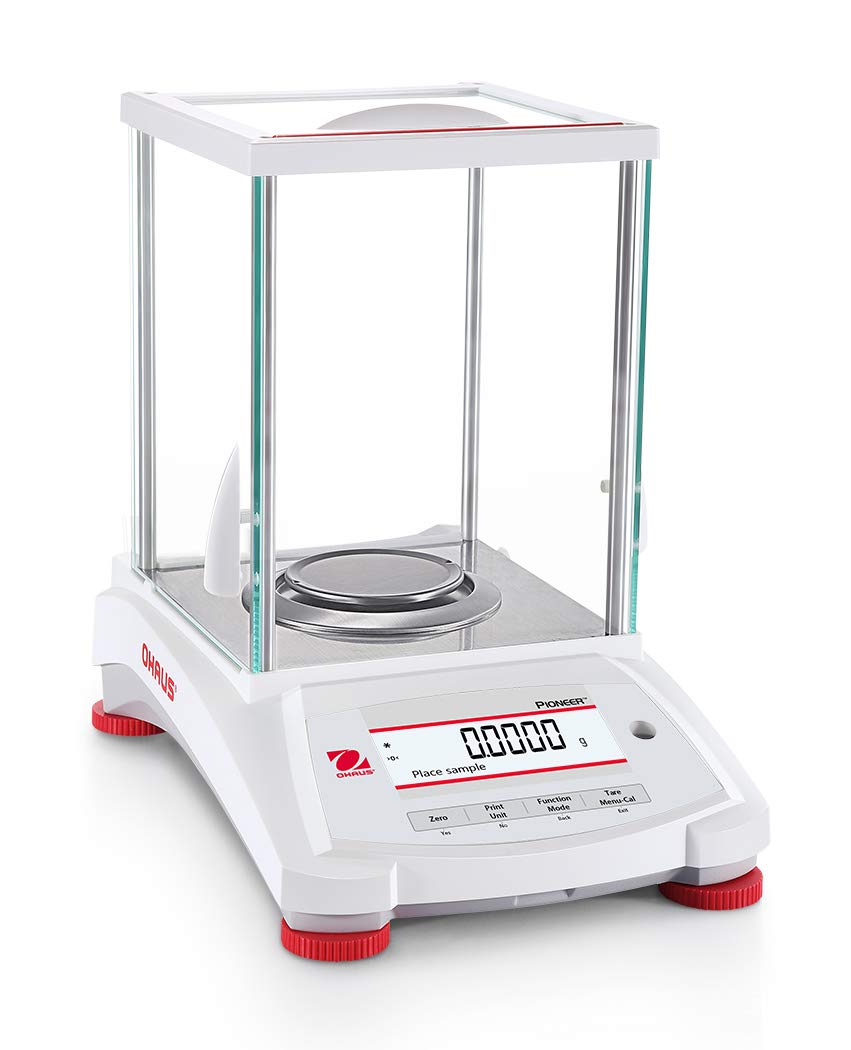
The Ohaus Pioneer Px85 Semi Micro Balance 82 Gram Internal Calibration is a Ohaus analytical balance. This guide explains what the Ohaus Pioneer measures, how this class of instrument works, how to match capacity and resolution to your application, what calibration it needs, and where to buy it in the United States.
Ohaus Pioneer specifications
| Manufacturer | Ohaus |
|---|---|
| Model | Ohaus Pioneer |
| Instrument class | Analytical balance |
| Availability | In stock — ships from the USA |
| Warranty | Full Ohaus manufacturer warranty |
| Calibration service | NIST-traceable, Cypress TX facility |
What is a analytical balance?
An analytical balance is a laboratory instrument that measures mass to 0.1 mg (0.0001 g) or finer inside an enclosed draft shield. At this resolution, air currents, temperature gradients, static charge, and building vibration all become measurable sources of error, which is why analytical balances use a windshield, a level indicator, and often internal motorised calibration.
How a analytical balance works
Analytical balances use electromagnetic force restoration (EMFR), not a strain-gauge load cell. A coil sits in a permanent magnetic field; when mass is applied, a position sensor detects the deflection and the servo loop increases coil current until the pan returns to its null position. The current required is directly proportional to the applied force, so the reading is derived from a measured electrical quantity rather than from mechanical deformation. This is what makes 0.1 mg resolution and long-term stability possible.
How to choose: what actually matters on a analytical balance
These are the specifications that change the outcome of a purchase, in the order they should be evaluated.
- Readability vs. required tolerance. A common laboratory rule is that the balance readability should be no coarser than 1/10 of the smallest tolerance you must control. To weigh a 10 mg sample to ±1%, you need 0.01 mg (semi-micro) resolution, not 0.1 mg.
- USP Chapter 41 minimum weight. For pharmaceutical work, the smallest usable sample is defined as 2000 × the repeatability standard deviation of the balance, giving 0.10% measurement uncertainty at a confidence level of about three standard deviations. Ask for the balance's repeatability figure, not just readability.
- Internal vs. external calibration. Internal (motorised) calibration lets the balance recalibrate itself on temperature change or time interval. External calibration is cheaper but requires an ASTM Class 1 or OIML E2 weight and disciplined procedure.
- Draft shield geometry. Glass shields with side-sliding doors disturb the chamber less than lift-off covers, and reduce settling time.
- Environment. A stone or heavy-composite anti-vibration table matters more than an extra digit of resolution on a bench that shakes.
Getting accurate results from the Ohaus Pioneer
Most complaints about scale accuracy are traceable to installation and procedure rather than to the instrument. The following practices apply directly to the Ohaus Pioneer.
- Let the balance warm up. Most manufacturers specify 30–60 minutes from power-on before the first calibration; EMFR coil temperature affects the zero point.
- Level the balance every time it is moved. A 1° tilt can change the reading measurably because the load vector is no longer vertical.
- Handle weights and sample vessels with tongs or gloves. A fingerprint is roughly 0.1–1 mg — a full display division of error at 0.1 mg resolution.
- Weigh by difference for hygroscopic or volatile samples: tare the closed container, add the sample, and re-weigh, rather than dispensing onto an open pan.
- Ground plastic vessels or use an ioniser. Static on a plastic weigh boat can shift a reading by several milligrams and produce a slow, one-directional drift.
- Readability (also written as d, or the display division) is the smallest change in mass the display can show. It is not the same as accuracy: a balance reading to 0.01 g may still carry a linearity error of ±0.02 g. Accuracy is bounded by readability, repeatability (standard deviation of repeated loads), and linearity combined.
Where the Ohaus Pioneer is used
- Analytical chemistry: standard and reagent preparation, gravimetric analysis
- Pharmaceutical QC and compounding under USP 41/1251
- Materials research, catalyst and polymer sample preparation
- Environmental testing: filter weighing for particulate (gravimetric PM) analysis
- University teaching labs in quantitative analysis
Calibration and verification requirements
Every weighing instrument drifts. Span error grows with load, zero drifts with temperature, and mechanical wear changes both. Two separate activities keep a scale trustworthy:
- Verification — placing a certified test weight on the scale and recording the reading, without changing anything. This is a check, and it is the record an auditor wants to see.
- Calibration (adjustment) — correcting the instrument's span so it reads the certified value. This should be done by a qualified technician with traceable standards and documented afterwards.
Guidance in NIST Handbook 105-1 is that the test weight's tolerance should be no more than one third of the scale's smallest division; many quality systems tighten that to one tenth. In practice that means an ASTM Class 1 weight for balances reading to 0.001 g, Class 2 for 0.01 g, and Class 4 or 6 for industrial platform and crane scales. Typical intervals are annual for general industrial use, semi-annual or quarterly under ISO 9001 or GMP, and immediately after any move, overload, or suspected impact.
Certified calibration and repair for the Ohaus Pioneer is available through our calibration service and repair service, and locally in Texas through Houston scale services.
Is the Ohaus Pioneer legal for trade?
In the United States, a scale used to determine the price a customer pays must be certified under the National Type Evaluation Program (NTEP) and sealed by the state or local weights-and-measures authority. NTEP evaluates a device against NIST Handbook 44 and assigns an accuracy class — Class I and II for laboratory and jewelry work, Class III for retail and general commercial weighing, Class IIII for coarse industrial use. Laboratory accuracy on its own does not make an instrument legal for trade, and a certified instrument loses legal standing if the seal is broken or the device is moved without re-verification. If weight determines money changing hands in your operation, confirm the NTEP Certificate of Conformance number before you buy.
Where to buy the Ohaus Pioneer in the USA
The Ohaus Pioneer Px85 Semi Micro Balance 82 Gram Internal Calibration is stocked in the United States by MNM Scales, a specialty weighing-systems dealer operating since 1998 out of Cypress, Texas. Buying from a scale specialist rather than a general marketplace matters for three concrete reasons on precision equipment:
- Calibration on arrival. A scale shipped without a pre-delivery check frequently needs adjustment out of the box, especially after air freight.
- Warranty registration. The manufacturer warranty is registered in the buyer's name, which matters if a load cell fails in year two.
- Service capability. Repair and recertification happen in-house rather than through a return-to-manufacturer cycle.
Our sister operations cover the same catalog: MNM Scales for the full multi-brand range and AllscalesUSA for nationwide sales and service. Both ship free to the mainland USA.
Frequently asked questions
What is the capacity and readability of the Ohaus Pioneer?
Capacity and readability for the Ohaus Pioneer are listed on the Ohaus product page; this model is supplied in a single configuration. Remember to subtract the weight of any container from capacity when planning your usable range.
What is the difference between readability and accuracy on the Ohaus Pioneer?
Readability is the smallest increment the display can show. Accuracy is how close the reading is to true mass, and it is limited by three things together: readability, repeatability (the standard deviation of repeated identical loads), and linearity (deviation from a straight line across the range). A scale can display one more digit than it can reliably guarantee, so the specification sheet's repeatability and linearity figures matter as much as the readability number.
What test weight should be used to calibrate the Ohaus Pioneer?
Use a certified weight at or near full capacity, with a tolerance no greater than one third of the scale's smallest division. For laboratory resolutions that means ASTM E617 Class 1 or Class 2; for industrial platform and crane scales, Class 4 or Class 6 is standard. Verifying only at low load cannot detect span error, because span error is proportional to the load applied.
How often should the Ohaus Pioneer be calibrated?
Annually for general commercial and industrial use; semi-annually or quarterly where ISO 9001, GMP, HACCP, or a customer specification requires it; and immediately after any relocation, suspected overload, or impact. Legal-for-trade devices additionally follow the inspection cycle set by the local weights-and-measures jurisdiction, which is usually annual.
Does the Ohaus Pioneer come with a warranty, and is it in stock?
Yes. Units are supplied new with the full Ohaus manufacturer warranty registered in the buyer's name, and the Ohaus Pioneer is currently in stock for shipment within the mainland USA. Check current pricing and stock for the Ohaus Pioneer.
Can the Ohaus Pioneer be repaired rather than replaced?
In most cases yes. The common failure points on this class of instrument are the load cell, the keypad membrane, the display ribbon, and the power supply — all replaceable. Repair is generally worthwhile when the instrument's replacement cost is high relative to the repair, and every repair should be followed by a full recalibration and a new certificate.
Summary
The Ohaus Pioneer Px85 Semi Micro Balance 82 Gram Internal Calibration is a Ohaus analytical balance. Match capacity to your heaviest load plus its container, choose readability at least ten times finer than the smallest difference you need to detect, verify with a certified weight on a documented interval, and confirm NTEP certification if weight will determine price. Ordering, warranty registration, and certified calibration for the Ohaus Pioneer are all handled in the USA.
Direct product link: https://mnmscales.com/product/ohaus-pioneer-px85-semi-micro-balance-82-gram-internal-calibration/
Technical questions about the Ohaus Pioneer? Call 832-290-3120 or message a scale specialist, Monday – Friday, 10 AM – 4 PM CT.
Explore related categories
Keep researching with the category, manufacturer and accessory hubs this model belongs to: