
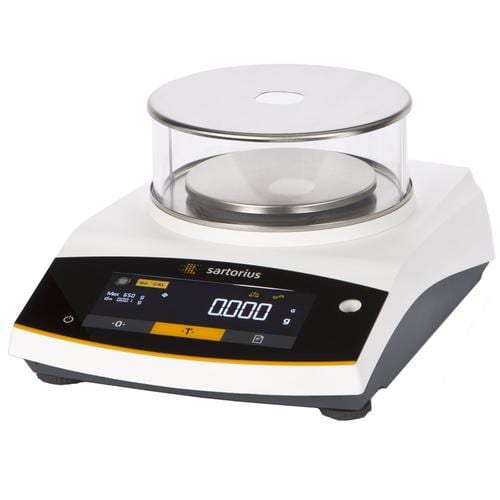
Sartorius BCE653 1S Entris Ii Basic Essential Toploading Balance 650 g x 1 mg 100 To 240 VAC 50 60 HZ Internal Cal
The Sartorius BCE653 1S Entris Ii Basic Essential Toploading Balance 650 g x 1 mg 100 To 240 VAC 50 60 HZ Internal Cal is a Sartorius precision balance with a 650 g capacity and 1 g readability (650 display divisions). It is used by labs, production floors, schools, compounding and food R&D, and is stocked and shipped from the United States.
Orders are fulfilled by our US sales sites, mnmscales.com and allscalesusa.com. Quantity and government pricing available.
BCE653 specifications
| Manufacturer | Sartorius |
|---|---|
| Model | BCE653 |
| Instrument class | Precision balance |
| Capacity | 650 g |
| Readability (d) | 1 g |
| Display divisions | 650 |
| Part number | BCE653 |
| Price (USD) | $2,160.00 |
| Availability | In stock — ships from the USA |
| Warranty | Full Sartorius manufacturer warranty |
| Calibration | NIST-traceable certificate available |
| Support | Cypress, Texas service facility — 832-290-3120 |
Capacity in other units
| Grams (g) | 650 |
|---|---|
| Kilograms (kg) | 0.65 |
| Pounds (lb) | 1.433 |
| Ounces (oz) | 22.93 |
| Troy ounces (ozt) | 20.898 |
| Carats (ct) | 3,250 |
What is a precision balance?
A precision balance (also called a top-loading balance) measures mass at readabilities between 1 g and 0.001 g, with a larger capacity and faster stabilisation than an analytical balance and usually no full draft shield. The BCE653 offers 650 g capacity at 1 g readability — 650 display divisions. It is the workhorse instrument for formulation, QC sampling, education, and any task where analytical-grade resolution is unnecessary but 0.1 g bathroom-scale accuracy is not enough.
Precision balances above about 0.01 g resolution may use either electromagnetic force restoration or a high-quality single-point strain-gauge load cell. A single-point cell is machined from one aluminium block with strain gauges bonded to flexure sections; it is corner-load compensated so a sample placed off-centre on the pan reads the same as one placed in the middle. EMFR models cost more but drift less with temperature and settle faster.
What the BCE653 is used for
- •Formulation and batching in food, cosmetics, and chemical production
- •Incoming QC sample weighing and yield checks
- •Education: physics, chemistry, and biology teaching labs
- •Density determination with a below-balance hook or density kit
- •Coating, plating, and filter-weight differential measurement
Setup, calibration and daily practice
- •Calibrate with a weight close to full capacity — span error is proportional to load, so a 100 g weight cannot validate a 3200 g range.
- •Use an ASTM Class 1 or Class 2 test weight for balances at 0.001–0.01 g. Handbook 105-1 guidance is that the weight's tolerance should not exceed 1/3 of the scale's smallest division.
- •Keep the balance out of HVAC airflow and off shared benches with centrifuges or stirrers.
- •Re-zero before every weighing rather than trusting an old tare; drift over hours is normal and expected.
- •Readability (also written as <em>d</em>, or the display division) is the smallest change in mass the display can show. It is not the same as accuracy: a balance reading to 0.01 g may still carry a linearity error of ±0.02 g. Accuracy is bounded by readability, repeatability (standard deviation of repeated loads), and linearity combined.
How to specify this class of instrument
- •<strong>Capacity headroom.</strong> Include the tare weight of your container. A 3200 g balance holding a 500 g beaker only leaves 2700 g of usable range.
- •<strong>Divisions as a quality signal.</strong> Capacity ÷ readability gives display divisions. Consumer scales run 1,000–3,000 divisions; laboratory precision balances typically run 30,000–320,000. More divisions means the manufacturer is confident in the load cell's linearity across the range.
- •<strong>Stabilisation time.</strong> Published figures are typically 1–3 seconds for a good top-loader. On high-throughput lines this dominates operator time far more than resolution does.
- •<strong>Interfaces.</strong> RS-232, USB, or Ethernet output matters for GMP/ISO environments that require an unedited electronic weight record.
- •<strong>Legal for trade.</strong> If you sell by weight, the instrument must be NTEP-certified (Handbook 44 Class II or III) and locally sealed. Laboratory accuracy alone does not make a scale legal for trade.
- •<strong>Draft shield option.</strong> At 0.001 g you will want one, even though the balance ships without it.
BCE653 manual summary
Unpacking and installation
Unpack on the bench where the instrument will live, fit the platter or pan, and connect the supplied adapter. Level the instrument using the feet until the bubble is centred, then let it power up and warm through before the first weighing.
Calibration and verification
Run the span calibration routine with a certified test weight at or near full capacity, then verify with a second weight near one third of capacity. Record both readings and the date in a calibration log.
Error codes and symptoms
| Symptom | Cause and remedy |
|---|---|
| Unstable / flashing reading | Air movement, vibration or an unlevel surface. Move away from HVAC vents and doors, level the bubble, and let the load settle before reading. |
| Over-capacity indication (E, EEEE, or ---- ) | Applied load exceeds capacity, or the platter is fouled. Remove the load, check nothing is trapped under the platter, then re-zero. |
| Will not zero at power-up | Something is resting on the pan, or the zero range was exceeded. Clear the pan and power-cycle. |
| Calibration fails or rejects the weight | Wrong nominal mass entered, weight out of tolerance, or the instrument was not warmed up. Confirm the certified value and repeat after warm-up. |
| Drifting reading over minutes | Thermal drift or static. Allow full warm-up, ground the instrument, and use an anti-static device for powders. |
Care and re-verification
Keep the platter clean and dry, avoid shock loading, store certified test weights in their case and re-verify after any move.
Documentation and literature
Every unit ships with the Sartorius operation manual covering keypad functions, span calibration, unit switching and error codes. The commissioning and calibration steps above summarise that documentation so the instrument can be put into service immediately. Need a copy of the manual, a declaration of conformity, or a NIST-traceable calibration certificate for the BCE653? Request it with your order or call 832-290-3120 and we will send it directly.
Sartorius Lab Instruments publishes the authoritative revision of this document in its own manual library. Our full manuals & literature library collects setup, calibration and error-code guidance for every instrument class we carry.
Read the full BCE653 buying guide
An in-depth guide covering specification trade-offs, standards references and comparable models.
BCE653 review & buying guide →Frequently asked questions
What is the BCE653 used for?
The Sartorius BCE653 1S Entris Ii Basic Essential Toploading Balance 650 g x 1 mg 100 To 240 VAC 50 60 HZ Internal Cal is a Sartorius precision balance with a 650 g capacity and 1 g readability. It is specified by labs, production floors, schools, compounding and food R&D.
What is a precision balance?
A precision balance (also called a top-loading balance) measures mass at readabilities between 1 g and 0.001 g, with a larger capacity and faster stabilisation than an analytical balance and usually no full draft shield. The BCE653 offers 650 g capacity at 1 g readability — 650 display divisions. It is the workhorse instrument for formulation, QC sampling, education, and any task where analytical-grade resolution is unnecessary but 0.1 g bathroom-scale accuracy is not enough.
How do I calibrate the BCE653?
Let the instrument warm up on a level, vibration-free surface, run its span calibration routine with a certified test weight at or near full capacity, then verify with a second weight at roughly one third of capacity. Record both readings; a shift larger than the permitted error at that load means the instrument needs service, not another calibration.
Does the BCE653 come with a manual?
Yes — every unit ships with the Sartorius operation manual, and the setup, calibration and troubleshooting steps for this class of instrument are summarised on this page so you can commission it without waiting for documentation.
Where can I buy the BCE653 in the USA?
Order from mnmscales.com or allscalesusa.com — both ship from the United States with free fast mainland shipping. Call 832-290-3120 to confirm stock or get a quantity price.
Customer reviews for BCE653
No reviews yet. Be the first to review this product.
Comparable precision balances
Other precision balances in the same class — compare capacity and readability before you commit.
Sartorius
Sartorius PRACTUM1102 1S Topload Balance 1100 g x 0.01 g External Calibration
Sartorius precision balance — 1,100 g capacity, 0.01 g readability.
$879.00
Sartorius
Sartorius PRACTUM5100 1S Toploading Balance 5100 g x 1 g External Calibration
Sartorius precision balance — 5,100 g capacity, 1 g readability.
$719.00
Sartorius
Sartorius PRACTUM5101 1S Toploading Balance 5100 g x 0.1 g External Calibration
Sartorius precision balance — 5,100 g capacity, 0.1 g readability.
$929.00
Sartorius
Sartorius PRACTUM2102 1S Topload Balance 2100 g x 0.01 g External Calibration
Sartorius precision balance — 2,100 g capacity, 0.01 g readability.
$919.00
Sartorius
Sartorius PRACTUM6100 1S Toploading Balance 6100 g x 1 g External Calibration
Sartorius precision balance — 6,100 g capacity, 1 g readability.
$769.00
Sartorius
Sartorius PRACTUM612 1S Topload Balance 610 g x 0.01 g External Calibration
Sartorius precision balance — 610 g capacity, 0.01 g readability.
$789.00
Sartorius
Sartorius PRACTUM412 1S Topload Balance 410 g x 0.01 g External Calibration
Sartorius precision balance — 410 g capacity, 0.01 g readability.
$699.00
Sartorius
Sartorius PRACTUM6101 1S Toploading Balance 6100 g x 0.1 g External Calibration Touchscreen
Sartorius precision balance — 6,100 g capacity, 0.1 g readability.
$977.00